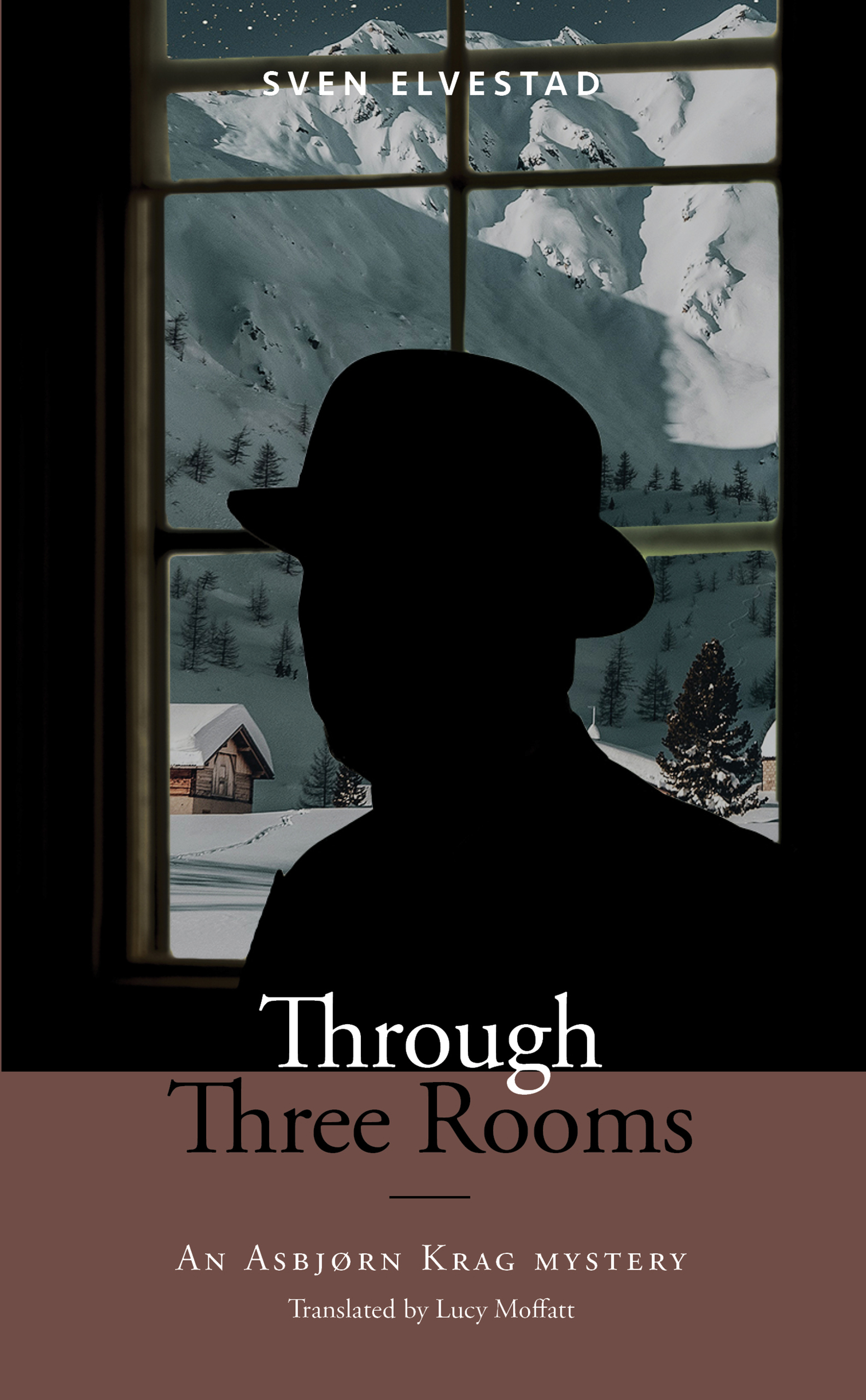
Barry Forshaw writes: To tie in with the new edition of Through Three Rooms: an Asbjørn Krag Mystery by Sven Elvestad, I asked my Norwegian pal Nils Nordberg (who has written the introduction) to talk to Crime Time about early crime Fiction in Norway,…
”The detective story needs more constructive imagination, more sense of composition and the economy of effects than any other form of fiction. The writer must be stringent; he must have a feeling for the mathematics of details, because everything has to fit into a strictly limited unity and point towards one definite denouement.”
This was not written by Agatha Christie nor by John Dickson Carr, though they would in all probability gladly have signed their names to it. It can be found in a first detective novel, Nattmennesket (‘The Night Person’), written by a 22-year-old Norwegian, André Bjerke, published in 1941 under the alias Bernhard Borge. The fact that he was also a poet and a translator of Shakespeare, Molière and Goethe, is likely to be more than a coincidence. There is a distinct and close family relationship between crime fiction, poetry and drama, all of them literary genres of strict rules but infinite variety.
And, after all, the modern crime story was invented by a poet, the American Edgar Allan Poe. That is at least the accepted truth. But the fact is that the first tales to deserve the name “crime story” in the sense that we use it today were written by a Norwegian, Mauritz Christopher Hansen (1794–1842). Like Poe he was a poor man of letters, a poet, essayist, novelist and short story writer, as well as a lexicographer and teacher.
And, like the American, he was influenced by the double forces of European Romanticism, with writers such as Sir Walter Scott, Friedrich Schiller and E. T. A. Hoffmann, and the philosophy of Rationalism, which had a strong footing in the merchant and civil servant classes to which both Poe and Hansen originally belonged. These two inspirations created in both writers a strong attraction towards mystery on the one hand, and, on the other, an equally strong desire to explain the inexplicable. Triggered by this and the growth of nationalism in Europe, Hansen set out to create something that hadn’t existed in his country before: a national prose literature. He wanted to describe, in realistic fictional form, the life of people of Norway. Here he parts ways with Poe, who was mainly interested in the soul. But both were led, like many others at the time, to the themes of murder and mystery.
Hansen wrote over 20 stories that in a broad sense could be classified as crime fiction. The earliest one was published in 1821, “Den gale Christian” (‘The Mad Christian’), a psychological thriller. In 1825 came what Hansen himself labelled a “Criminalhistorie” (‘crime story’), the short novel Keadan, eller Klosterruinen (‘Keadan, or the Abbey Ruins’). But although there certainly are murder and plenty of mayhem as well as a court trial in this tale set in a remote mountain community of Norway, it doesn’t quite make the mark; with its strong emphasis on romance and rambling storyline it is popular melodrama, rather than crime fiction in the generic sense.
The short story simply called “Novellen” (‘The Short Story’), published in 1827 is, however, a different matter. In it, an old and odd tale about a local madwoman forms the basis of one man’s speculations about what really could have happened, and a murder plot is uncovered. But it isn’t presented as the resolution of a mystery, but rather as an exercise in literary technique, a demonstration of how real life can be used as material for fiction, hence the title. And so “Novellen” misses by a split hair the honour of being the world’s first armchair detective story.
But it did point in the right direction. And in the short story “Jutulskoppen” (1836, ‘The Troll Mountain’) there are two murders, an innocent suspect, an investigation by means of documentary evidence, a trial and a sensational court-room revelation of the real culprit (the suspect’s husband, in fact), in the fashion of Perry Mason a hundred years later.
Then, at the end of 1839, Hansen published the short novel Mordet paa Maskinbygger Roolfsen (‘The Murder of Engineer Roolfsen’).
It is set in the author’s native city of Kongsberg in the late 18th Century and focuses entirely on the investigation of a suspected crime committed by person or persons unknown. There is a detective, lawyer and local chief of police Barth, who patiently and persistently interviews suspects and witnesses and gathers clues – one of them provided by an early example of forensic chemistry – which are all presented fairly to the reader. Putting all his information together, Barth arrives at a surprise double solution – one of them being that the guilty party is the city’s most powerful man, the one who has urged most strongly for a quick and successful result of the investigation and the other – well, the very title contains an Agatha Christie type of fair misdirection: Roolfsen wasn’t murdered but made to disappear in such a fashion that everybody thought he had been. The detective is, in contrast to messieurs Dupin, Holmes and Poirot a realistic, everyday character, even to the point of having a weak spot: The chief suspect’s mother was the love of his young life; she refused his proposal, thinking herself socially beneath him, but he still harbours feelings for her.
There can be no doubt that Mordet paa Maskinbygger Roolfsen, written a year and a half before Poe published “The Murders in the Rue Morgue,” was the world’s first detective story proper. But Hansen wrote for a very small readership, basically the couple of thousands who formed the educated classes of contemporary Norway. And when he died shortly afterwards, he had few followers. No one attempted another detective story, but some writers continued to write sensation novels in which crime played a part.
And there was yet no market for popular mass fiction. What little there was, tended to sympathize with the law-breaker rather than the police. The autobiography of master thief Gjest Baardsen, written in prison, was one of the most popular books in those mid-19th-century years.
Hansen did have one famous pupil, though. The retrospective technique employed by Henrik Ibsen in his contemporary plays, where secrets of the past are revealed, layer by layer, owes a great deal to Hansen’s example. And Ibsen, of course, was no mean thriller writer.
Some of Hansen’s stories were published in Germany. Were they seen by a certain American writer who could read German (and, incidentally, set one of his stories in Norway)? It remains at best a shadowy possibility.
But despite Mauritz Hansen’s achievement, the history of Norwegian crime fiction properly begins in 1897, with the publication of Karl Monks Oplevelser (‘The Adventures of Karl Monk’), which contained two long stories about a former Head of the Kristiania (Oslo) C.I.D. turned private investigator.
By then, the great pioneers of the genre, such as Gaboriau, Collins, Fergus Hume and Conan Doyle, had been published in translation and the detective story had quickly become immensely popular, especially with the rapidly increasing middle class. And the working class reading audience had multiplied, paving the way for cheap fiction of the penny dreadful kind, much of it marginally crime fiction. Norway had grown into a very different country from the one that Mauritz Hansen knew, a modern world of steam engines, electricity, telephones and bicycles, and with a capital that had speedily grown into a small metropolis, complete with an underworld.
Karl Monk was created by the Navy officer, later Admiral, Christian Sparre (1859–1940), writing under the pseudonym Fredrik Viller (this was the start of a long tradition of using aliases for crime writing in Norway). Monk is described as “the complete opposite to Sherlock Holmes”, and true, he is a more emotional character – he resigned from his police job for the love of a woman who was a suspect in a case. But there isn’t really much doubt as to where he finds his inspiration; like everybody else at the time, Viller/Sparre found it difficult to escape from under the shadow of the Master of Baker Street.
So did at first Sven Elvestad (1884–1934), journalist and sybarite extraordinaire, who published a couple of detective stories at the tender age of 17 and then started in earnest two years later, in 1904. Elvestad’s private detective Asbjørn Krag (altered to Osborne Crag in one English translation!), also a former police investigator, is mysterious, romantic, infallible and aristocratic. But over the years he develops a rather split personality; on the one hand he is a full-blooded action hero, always on the track of some master criminal, quick to brandish guns and command the railway’s “latest steel giant” in order to pursue the villains; on the other – in Elvestad’s best novels – he is a patient, quiet but unrelenting hunter of the truth, willing to spend unlimited time waiting for the villain to break down, rather similar to Porfiry Petrovich in Crime and Punishment by Dostoevsky, who was an important inspiration to Elvestad, along with Doyle and Poe.
Sparre continued to publish new books sporadically, some of them thrillers and spy stories rather than detective stories, over the next couple of decades. But he and others of the time were overshadowed by Elvestad, who, it can be claimed, was the first golden age of Norwegian crime fiction. And his influence is still felt; his police detective Knut Gribb, created for a penny dreadful series in 1908 to compete with Nick Carter who then had his breakthrough in Scandinavia, was given a permanent life in magazines and books and is at present the hero of a popular radio drama series. By now, more than 80 writers have contributed to his saga, and if Gribb doesn’t top the list in the number of adventures (about 1,500 against Sexton Blake’s nearly 4,000) he is certainly the longest running.
Elvestad, who used the crime writing alias of Stein Riverton in Norway and Sweden, but was published under his real name elsewhere (in fact, he was baptized Kristoffer Elvestad Svendsen), was immensely prolific. Even while producing every week for seven months a 60-page story about Knut Gribb, he continued to write of Asbjørn Krag and pursue his calling as a journalist. In all, he published 90 titles. Only a small handful of his crime fiction was short stories, the rest varied from short up to full-length novels. In later years he sometimes had to call in a ghost writer in order to meet the demand.
And his popularity didn’t stop at the borders; in the years from 1910 to 1925 he reigned supreme as King of Crime in northern Europe; he had books published in 17 languages, including Hungarian, Spanish and Serbo-Croat, and he had a particularly large following in Sweden and Germany. In fact, there were more titles published by him in those countries than in his native Norway. Very few were translated into English, though, but Fænomenet Robert Robertsson (1925, The Case of Robert Robertson) was published in the U.S.A. and received high praise by no less of an authority than Dashiell Hammett.
His books were highly topical; they spanned all layers of society from the alluring demi-monde of the restaurants to the mean streets of crime and squalor; they caught the pulse of their time. Elvestad considered the detective story the perfect fiction for the modern age of speed and technical innovation, “the age of the screaming disharmonies”. He was himself part of this world; most of the novels were written for magazine and newspaper serial publication and then appeared in book form. They were composed at restaurant tables and in hotel rooms while the author pursued the noisy “moveable feast” that he craved, often with the office boy waiting at his side to take the next chapter to the printer. In consequence, too many of them are loosely plotted and haphazardly developed. But Elvestad was never less than a brilliant stylist – there is an echo of the early Hamsun in his work – and even in his less successful stories there are gems of description, where time and place come marvellously alive.
And a dozen or so of his books are truly great. A couple of them belong arguably among the best crime novels ever written, both tales of haunting psychological terror: Jernvognen (1909, ‘The Iron Chariot’), a murder mystery set in the pale Nordic summer, anticipates by 17 years the trick that Agatha Christie would use in The Murder of Roger Ackroyd (it may have been suggested to Elvestad by Anton Chekov’s The Shooting Party). And Morderen fra mørket (1913, ‘The Killer from the Dark’), based on an actual, still unsolved Swedish murder case, has a similarly surprising denouement and an intensely observed feeling of nature and light – or darkness as it were: in contrast to Jernvognen it is set in the bleakest part of winter.
Elvestad was an international celebrity with a distinct appearance, gigantic in stature, but extremely myopic and with a face and a circumference that betrayed his passion for food, drink and tobacco. As a journalist he was capable of all kinds of stunts, he was also one of the first foreign reporters to interview the rising leader figure of the German Nazi Party, Adolf Hitler, and he spent a lot of time abroad, especially in Sweden, Germany, and Italy. But in his best work – characteristically, one of the novels he published under his own name in Norway, is called Angsten (1911, ‘The Fear’) – the face of another man appears, a complex personality, deeply concerned with guilt and anxiety, the man who wrote prophetically about the rise of militarism and the possible abuse of technological progress long before World War I. Curiously, in his later years he became an admirer of Mussolini and Fascism, though it is hard to picture him marching along with booted Blackshirts; he was too much of an eccentric and individual for that.
Nils Nordberg is a Norwegian crime writer, anthology editor and audio play director. He has worked for the Norwegian Broadcasting Corporation since 1969, and for Radioteatret since 1973.
Through Three Rooms: an Asbjørn Krag Mystery by Sven Elvestad, a new translation by Lucy Moffatt with an introduction by Nils Nordberg (£12.99) is available at www.kabatypress.com, online and to order in most physical bookstores.