Of the dozens of notable writers to have served in British intelligence, John Bingham shines.
 From the early 1950s onward, Bingham pioneered the kind of dark, realistic psychological crime novel that has since become a genre norm. Yet most of his readers and champions were unaware that weekday mornings found him at his desk in the headquarters of the Security Service.
Admired by his colleagues – among them a young David Cornwell, aka John le Carré – Bingham served in MI5 for forty years. This alluring double life saw him monitoring threats to national security by day while writing cutting-edge crime novels by night.
For many years Bingham was loath to write spy fiction, feeling it would be insecure and disloyal to ‘The Office’. It wasn’t until the mid-‘60s, when he saw the wild success enjoyed by his former protégé le Carré, that Bingham relented and created a serial spy character – the cerebral intelligence officer Kenneth Ducane.
Bingham died in 1988, and today is best known for things that have little to do with his books. One is being the father of writer Charlotte Bingham, whose work outsold his and who has published a memoir of her own spell at MI5.
But above all Bingham is renowned for being the real-life inspiration for George Smiley, John le Carré’s most successful character. The young David Cornwell even based his pen name on his esteemed MI5 mentor. The origin of ‘John’ is obvious, while ‘le Carré’ – in French, ‘the Square’ – was Cornwell’s affectionate nickname for the older, more tightly-buttoned Bingham.
Reputedly, Smiley was a close counterfeit of Bingham – especially when portrayed by Alec Guinness for BBC television. Picture Guinness in the role: the black-framed glasses with big friendly lenses; the soft voice, going tungsten-hard when necessary; the unselfconscious charm and steady pace; the expert questioning, and even more expert listening; the piercing objectivity…those who knew Bingham have said the likeness was uncanny.
But the Bingham-le Carré relationship is far from trouble-free. Several spats have broken out between le Carré and supporters of Bingham. One public row was conducted entertainingly in the letters pages of The Daily Telegraph. The gist of it – as with previous blow-ups – was that le Carré exploited his friendship with Bingham for his own gain.
In so doing, le Carré was charged with various offences. These included unjustly overshadowing Bingham’s talents as a novelist; making disloyal attacks on the British intelligence services, which served only to strengthen the position of the KGB; and even undermining the recognition that Bingham should’ve received for his Second World War counter-espionage work.
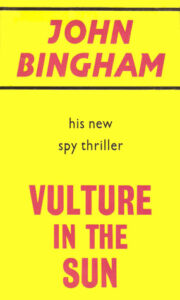
Yet in all this noise about exploitation and revelation, Bingham’s own spy novels are rarely mentioned. Which is a pity, because at least three – The Double Agent, Vulture in the Sun and Brock and the Defector – have real quality. Don’t overlook them.
Spy-writers, writer-spies
 It’s easy to lose count of the number of noteworthy writers who’ve served in British intelligence.
Alongside le Carré, W. Somerset Maugham and Grahame Greene are cited most often. Today the ranks of spy-novelists include a former MI5 director in Stella Rimington, and former ‘soldier and diplomat’ Alan Judd. It’s a strong field, and is the focus of an entertaining collection of extracts edited by the writer Michael Smith – who served in military intelligence – called The Secret Agent’s Bedside Reader.
Some of the book’s standout pieces are the real reports, and instructive guides, written by spies. Although it’s a pity Smith didn’t unearth a report by Jane Archer – MI5’s first female officer, who in 1940 conducted what the historian Christopher Andrew called ‘the first really professional debriefing of a Soviet Intelligence officer on either side of the Atlantic’.
One highlight is a pithy Second World War dispatch by Kenneth Benton of MI6, in which he assesses the risks of employing a ‘walk-in’ who has offered her services as an agent. It’s better than most of Benton’s 1970s thrillers, even if they did propel him to be president of the Crime Writers’ Association.
These reports’ qualities suggest why some spies write well. A good intelligencer has imagination and intuition; observational and analytical skills; a flair for spotting the essence of something, and capturing it in clear, compelling language; the ability to impose a disciplined flow to information, grabbing the attention and persuading the reader.
Bingham wrote in this succinct way; economically, and with an almost painstaking clarity. At various points he worked as a journalist, and it shows: his novels have the feel of tense reportage. This gives a realism and subtle power to all three of his best spy books.
What did you do in the war?
 What did Bingham do at MI5? The best source on this – as on all things Bingham – is Michael Jago’s sensitive biography, The Man Who Was George Smiley.
Upon joining the Security Service in 1940 Bingham was singled out for several roles. These duties give clues to the sleeping novelist who would awake after the war.
An MI5 organisational chart from April 1941 shows Bingham as head of Section B.1.D., ‘Special Examiners’. This refers to the interrogation of suspected spies among the flood of escapees from German-occupied Europe. Bingham interviewed huge numbers of them, filtering the small minority of planted Axis agents from the mass of honourable refugees.
He also worked as a press liaison officer; tested the security of ports and munitions factories, sometimes burgling the latter in the line of duty; persuaded captured enemy agents to work for the Allies; and went on operational drinking sprees in provincial pubs and London nightclubs.
In the latter role, Bingham would strike up conversations with the clientele to see what, if anything, an unassuming fellow drinker could pick up about the war effort. As well as checking the level of security observed by the public, this socialising served another purpose. The innocuous rumours he gathered served as useful ‘chicken feed’; they were reported to Berlin by captured Axis agents operating under British control. This helped to convince the enemy that their spies in Britain were roaming free, and carrying out their missions.
After the war Bingham monitored the communist movement and – given his Anglo-Irish heritage – worked on the Troubles in Northern Ireland. (He later described Ulster unionists as ‘the most intransigent people I have ever met’.)
But his most celebrated achievement was his role as Second World War agent provocateur. Posing as a Far Rightist with links to German intelligence, Bingham would identify British fascists and pro-Nazis, and facilitate the treasonous acts that ultimately – thankfully – took them off the streets.
One of these operations is described in Robert Hutton’s excellent Agent Jack, the biography of long-term MI5 agent Eric Roberts. Bingham befriended one Irma Stapleton, a fanatical fascist and racist. She leapt at the chance to steal technical drawings and weaponry, and offered to sabotage – even burn down – the munitions factory in which she worked.
The sting climaxed in a hotel room at Marble Arch. Stapleton had just handed Bingham her stolen booty when Special Branch detectives – who were listening to the exchange from an adjacent room – burst in to arrest her. She protested, claiming that Bingham was the real Nazi agent. Bingham played his part to perfection, attempting to flee before being roughly subdued and carted off.
Stapleton was convicted but, with customary leniency, served only a few years of her ten-year sentence. Her absence from the war effort wasn’t lamented. In the course of her acquaintance with Bingham she regularly expressed her detestation of British people, described Jews as ‘dirty, slimy beasts’ who were ‘always fermenting trouble’, and once stated, ‘I would be willing to sacrifice my life to kill Churchill.’
Why did he do it?
 It’s clear that Bingham found his metier in two things: writing and MI5. But why did he work there?
Bingham was conservative by nature and an aristocrat by birth: the 7th Lord Clanmorris. But above all he was a well-travelled patriot who believed that political moderation was the hallmark and cornerstone of any contented society.
Bingham doesn’t appear to have recognised the deprivation experienced by many working people. This blindspot was not to his credit. Even so, as the 1930s progressed he became horrified by the rise of political extremism, right and left. He spotted the killer flaws common to both: their presumptuousness and sophistry; their unwise intolerance and banal aggression. As Jago puts it, ‘Wherever he looked, he saw either selfish perpetuation of the status quo or selfish determination to destroy it.’
In the end, you could say Bingham’s political sensibilities were those of the artist. That is, a patchwork of values, and thoughtful responses to life, which don’t fit neatly into organised politics. And in his novels one can see his safety valve, the preoccupation which saved him: his deep interest in human beings.
This non-judgmental fascination with humanness can also be seen in the work of Hans Fallada, Patricia Highsmith, Georges Simenon. Bingham was a natural watcher, a student of our behaviour. One gets the feeling he would’ve responded to most unwelcome social developments with a wry and incredibly sad smile.
Perhaps that’s why he knuckled down to writing far-sighted novels and a job at MI5; an organisation in which, according to Jago, ‘he felt he could do the most good’. For Bingham, intelligence work was not an opportunity to sate political desires. It was a matter of communal safety. As for politics, he left that to people with colder blood and more heated ideologies.
And how does his life surface in his spy novels?
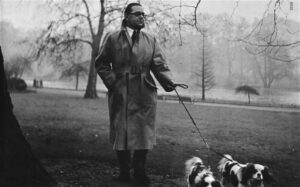 Bingham based his intelligence officer, Kenneth Ducane, on himself. Except Ducane appears to work for MI6, not MI5. But then we know that Bingham was wary of writing about his own outfit. If he was going to foul anyone’s doorstep, he made sure it was that of the Secret Intelligence Service.
Ducane is clever and subtle, likeably soft-voiced, very calculating. In The Double Agent – runner-up in the 1966 CWA Merit Award – he exploits a commercial traveller called Reg Sugden, whose job allows him to travel behind the Iron Curtain. Trained as a courier, and sent east with great fanfare, Sugden is merely bait for the KGB: the end goal is for Ducane to discover which of his fellow officers is a Soviet mole. Sugden is duly captured, and things look grim indeed. But the tale ends with a thumping twist – Bingham’s tales often do.
Vulture in the Sun also has a protagonist who’d rather be elsewhere. Tom Carter is an intelligence officer sent by Ducane to babysit a small spy network on Cyprus, while its usual boss takes a stress-related holiday. It’s not a good time for a secondment – the island is gripped by communal violence, and Carter is soon caught-up in a multifactional killing spree. He struggles to discern who is a threat and who – if anyone – is a friend; but he, and we, are kept guessing to the end.
Brock and the Defector was Bingham’s last book, published in 1982. It’s underrated – it has all the pace and tension of his earlier successes. Bingham intended Inspector ‘Badger’ Brock to be a serial character, a response to the success of Morse. But this novel sees Brock take a back seat to Ducane, who must work out if a Soviet defector is bona fide or a plant. Things get complicated when one of Ducane’s agents falls in love with the Russian, and corpses start turning up. The writing is typically brisk, and there’s the gnawing sense of unease which Bingham does so well.
These novels are full of the human problems of spy work. The delicacies of agent-handling; the grim need to turn the screws on people; the sussing out of defectors, and fake defectors. Bingham doesn’t bother much with technical tradecraft. Instead, he poses human questions: How do you spot a lie? How do you weigh one risk against another? What’s the real motive underlying a person’s behaviour?
And there’s a curious thing about The Double Agent – it seems to foreshadow le Carré’s Tinker Tailor Soldier Spy. Ducane scrutinises his colleagues, trying to spot the Soviet mole: is it arid intellectual Henry Blundell? Or overdrawn art-lover Peter Foster? And so on. Le Carré’s novel picks up that scenario and runs with it. Bingham couldn’t have written Tinker Tailor. But he could’ve inspired it.
Seconds away
The Bingham-le Carré tensions go back decades. In the late 1970s Bingham’s wife Madeleine, and at least one of his (female) MI5 colleagues, wrote to le Carré to vent their spleen.
Among other complaints, Madeleine was furious about le Carré’s indiscretion. While in his fiction her husband ‘had remained scrupulously reticent about operations at MI5, le Carré had trumpeted them about’, to quote Jago.
Even so, it seems that Bingham didn’t really agree with his own defenders. He liked le Carré and was mostly flattered by being Smiley. He was also aware that at least one other figure in le Carré’s past – a former teacher – had influenced the character.
The one thing Bingham deplored – intensely – was le Carré’s querulous negativity about British intelligence and its personnel. And this is the major difference between the two novelists’ work.
For a true-blue intelligence officer, Bingham’s Kenneth Ducane novels are brutally frank about the moral messes of spying. But the thing that is totally absent from Bingham’s work – and which seeps through le Carré’s – is the suggestion that western free-market democracy might be just as corrupt and compromised as Soviet communism, and barely worth defending.
Like le Carré, Bingham knew that spying can be tough and unpleasant. And like Bingham, Ducane believes that nothing made by humans is flawless or indelible. But even when fulfilling his duties regretfully, Ducane knows which system is worse. He hasn’t the shadow of a doubt that he’s on the right side. Ducane’s certainty – and Bingham’s – is reassuring and refreshing.