The author of the Charles Thoroughgood series talks to Crime Time.
 There are thousands of spy novels, but there is only one Charles Thoroughgood. Written by former soldier and diplomat Alan Judd, the Thoroughgood series – of six books, so far – is a deep pleasure for all those sensible enough to follow it.
Kicking off with the Northern Ireland-based A Breed of Heroes, the series sees Thoroughgood progress from British Army officer to chief of MI6. Along the way he tackles tricky Russian defectors, self-aggrandising traitors, the kidnapping of his wife, and wrong-headed activists mucking around with radiological weapons.
These novels have special strengths. They’re delivered in an elegant, conversational style that makes the pages zip by. They are authentic and plausible, with subtle plots and substantial themes. While he is a political agnostic, Thoroughgood – unlike many spy protagonists – exudes a wholly appropriate patriotism that sits comfortably alongside his cosmopolitanism. And the often-positive portrayal of spies and spying is like a blast of fresh air through a musty teenaged bedroom.
As well as their literary merits, these books give an almost real-time commentary on matters of espionage and national safety in the 21st century. With an unusual prescience, issues such as the use of China-made technology in infrastructure were examined long before the media got to them.
Alan Judd spoke to Crime Time from a corner of locked-down southern England.
As well as the Thoroughgood series, you’ve published much literary fiction and non-fiction. How do you prioritise the different strands of your work?
It’s a combination of having something you want to write about and publishers’ enthusiasm. If the publishers want another spy book, that’s what I tend to do. But I’ve never written a book I really didn’t want to write. My next book, for example, is about Christopher Marlowe, Shakespeare’s contemporary. It’s something I’ve thought about for thirty or forty years. He’s an interesting figure, and ambiguous – rather Dostoevskyan, when you think about it. In his plays, he doesn’t shy away from the brutal stuff. And the coincidence of being born in the same year as Shakespeare, and the fact that he died aged just twenty-nine, are thought-provoking.
 You’re prolific and publish regularly. Do you have a writing routine?
For much of my writing career I was working full-time in the Foreign Office. My routine then was to make myself write on four days out of seven – evenings and weekends, basically – with a minimum amount each day. But the minimum was low enough that I knew I could do it.
Now that I’m writing full-time, I tend to write in the mornings. I work in a little office near the house, so have a fifty-yard commute. I then try to do something outside, or physical, in the afternoons. I think Graham Greene would write about five hundred words early in the morning, which left him free for the rest of the day. And P.G. Wodehouse only wrote about five hundred words a day – if you do it daily, it’s surprising how it mounts up.
You had an encounter with Graham Greene…
I met him when I was working on my Ford Madox Ford biography. Greene knew Ford a little, and had written about him. So I wrote to Greene via his publisher, asking if I could talk to him, and he invited me to his flat in Antibes. I spent about six hours with him, drinking a lot of whisky. He microwaved supper and we had a good chat. It inspired my novella The Devil’s Own Work.
What’s your preferred spy fiction?
Somerset Maugham’s Ashenden stories are among the best, because they’re the most realistic. I like much of le Carré. You can see two traditions in spy fiction, which have developed in parallel – the adventure tradition of Bond and the guilt-ridden, moral-quandary tradition of Greene and le Carré. I’ve enjoyed both. Some of the early Bond novels were good, and Fleming can be underrated as a writer. He was like Raymond Chandler in that he made things happen – on every page there’s colour and movement.
Why have so many spies been noteworthy writers?
In Britain, I suspect some of it is due to the recruitment policy of the intelligence services. Our three principal intelligence agencies are all civilian, whereas in many other countries they’ve been military. So in a national crisis like the world wars, or a slow-burning crisis like the Cold War, the intelligence services were joined by people who might’ve become writers anyway, or who were already writers and probably wouldn’t have joined the military. Intelligence also gave them something to write about, a theme to mine.
Your ground-breaking biography of Sir Mansfield Cumming, first chief of MI6, begins with the dedication ‘To all who have served and remained silent’. What’s your view on the need for discretion among spies-turned-writers?
It can be difficult with memoir. For example, if [former MI5 director] Stella Rimington has experienced any disapproval from her former employer, it’s not for her fiction but her autobiography. Although she did all the right things – correctly submitted it, removed what she was asked to remove. But I don’t think they wanted her to publish it, at all. With fiction, though, the intelligence agencies take a pretty sensible and tolerant approach. As long as it’s not giving away real incidents or people, they’re pretty good about it.
 Did you have any concerns about publishing A Breed of Heroes? It was unusual to see a novel about the Troubles from the perspective of a British soldier…
I was in the Foreign Office by then – they had to agree it, and they sent it to the MOD. Neither asked for any alterations. I’ve generally found the bureaucracy to be understanding and tolerant, as long as they feel you’re not trying to pull a fast one.
One great strength of the Thoroughgood series is the way it provides a running commentary on the state of play within intelligence agencies…
The books reflect changes I’ve heard about, or issues that I think are important to get out there. I’m trying to show that people in spy organisations are ordinary people. They have domestic and personal lives just like everyone else. They go to work and they come home. They’re not somehow different.
I try to write the stories in such a way that people who work in intelligence will find them hypothetically possible, rather than absolutely out of the question. But I also write them for people who want to know about these agencies – to have a story, but to be in touch with the reality.
How would you describe Charles Thoroughgood to someone who doesn’t know him?
He’s calm, fairly cautious. He’s patriotic. He wants to do things, to make things happen, but he’s measured and undemonstrative. And things happen to him, quite a bit.
He gets things wrong now and again, of course, but generally he’s well-intentioned. Not as conscientious or punctilious as the ideal public servant, but not ill-meaning.
He’s a useful vehicle. I can show-up things through him, through his perceptions. For me as a writer, he’s like a comfortable glove – you don’t really notice he’s there.
The first two Thoroughgood books were standalone novels written twenty years apart. What inspired you to turn them into a series?
I didn’t set out to write a series. None of the books was written with the intention that there would be others. But I realised that I had something to say, to contribute in this area. No-one else was writing about the intelligence world in quite the same way.
There’s room for people to write about it in all manner of ways, of course. Showing that intelligence work is bureaucratic, rather than all thrills and spills, doesn’t necessarily make for better novels, but I still think there’s a place for it.
 It’s almost the norm for British spy novelists to focus on the negative aspects of espionage. The Thoroughgood series doesn’t. Do you see intelligence as a mostly positive activity?
I’ve consciously had a different focus, because so much spy fiction depicts a world of grubby moral compromise and people betraying each other. I believe that in our intelligence agencies, and our bureaucracies in general, loyalty is one of the most common characteristics. But if you read most spy fiction, you’d believe that disloyalty was the most common characteristic.
There’s a common assumption in the artistic community that anything corporate is malign. But no organisation could function if everyone betrayed one another, or if no-one liked or trusted anyone else. I wanted to show that intelligence bureaucracies, like others, are full of variability.
If intelligence is controlled by a government like that of the Chinese Communist party or Vladimir Putin, it won’t be very nice. But if it’s under proper democratic control, generally it aims to be better. It’s a reflection of the political culture that it serves. And people in British intelligence agencies really do not go around bumping people off.
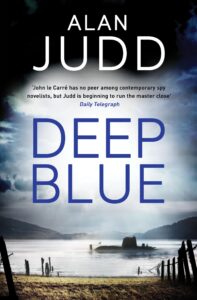
In ‘Deep Blue’, Thoroughgood assures a political activist that 99.9 percent of people are of no interest to intelligence services. These passages seem to be setting the record straight about the boundaries of intelligence…
I try to make the point, to all those millions of people who assume that intelligence agencies are monitoring their phones and computers all the time, that they should stop and ask themselves: ‘Why should they be at all interested in me?’ Agencies only become interested if a person tries to do something that’s against the law. And even then it has to be something pretty dramatic to even come to attention.
What do you think is the public and media perception of intelligence agencies at the moment?
The public perception is probably, ‘They’re like the armed forces; we need to have them, they’re supposed to protect us, and let’s hope they’re getting on with it.’ Often with the routine assumption that intelligence agents are permanently armed. The media perception is that agencies are constantly trying to do what they shouldn’t, to undermine civil liberties. Both perceptions are heavily influenced by film and television.
It’s still quite common for MI5 to be thought of as a kind of commando unit that bursts through the windows if they hear something they dislike…
Yes, and the idea that if you hear clicks or funny noises on your phone it means somebody’s listening. Whereas if your phone is being intercepted, the reality is that it will work better. They make sure it works.
Agencies do seem to get tied-up with regular legal challenges…
It’s a troubling element, because they are a real imposition on intelligence services. Both in terms of inhibiting what they can do – because they have to take potential challenges into account – but also the numbers of lawyers they have to employ. With the costs coming out of their budgets. In the 1970s, I think there was one lawyer employed by MI5. They shared him with MI6.
What’s your view on Edward Snowden-type whistle-blowers?
Much of it stems from what, in an oversimplified way, we’d call the cult of the individual. The idea that if I think ‘x’ then I can do ‘y’, provided it’s what I sincerely believe in. Very few of them seem to consider the option of saying, ‘Well, I don’t approve of what my organization is doing; I’m going to tell them I don’t approve of it, and ask to be moved to other work.’ Which they’re quite able to do.
 What do you think of the drive for openness, both in terms of historical study and biography, and the current work of agencies?
There has been a massive change. It’s very hard to disapprove of openness, as long as it’s controlled and sensible. And openness on historical matters can be demonstrably harmless, so why not? On the other hand, openness nearly always leads to being more open than you should or wanted to be. So it is a double-edged sword.
The Waldegrave Initiative of the 1990s – to increase access to government archives – made a big difference. When I was asked to do the Mansfield Cumming biography, using the diaries which had been kept by successive chiefs of MI6, it was partly in response to that initiative. MI6 didn’t want to release their own files, which MI5 do, historically; but they were prepared to make that kind of exception.
Your plots are subtle and driven by human mysteries, such as trying to discern a person’s intentions. Why do you favour intellectual, ethical and behavioural puzzles over physical action?
Well, why do people spy? It’s one of those fascinating questions of intelligence. There’s a whole range of motivations for spying, good and bad. And the thing that’s so interesting, I think, is what leads-up to people doing it. How people can be tempted into spying or tempted away from it. Or questions such as, what’s the difference between a Snowden and a Gordievsky? [The latter a British mole in the KGB who greatly increased Western knowledge of Soviet spying.] Very often, there’s more than one motive for spying; there’s a mixture.
The Thoroughgood books are full of asides on the internal problems of all organizations; ego battles, silly management cultures that distract everybody. Why are you interested in how an organization functions?
Because it’s how the world works. The world is largely bureaucratic, or driven by bureaucracy of one sort or another. It has an enormous effect on our lives. And for many people, work is their stage; it’s where the public part of their life is lived out and dramatized. It’s also a source of quiet comedy, which is always welcome. Professional jargon, for example. Jargon has become a kind of smokescreen, almost a weapon of war. Neologisms, where we had a usable word to begin with – you think, ‘Actually, we call that a wheel, and it’s existed for some time.’
Why did you take on Brexit in the most recent novel, Accidental Agent?
It has its place as a subject, and it was happening when I started writing the book. But also to show that spying is not always about weapons secrets or battling an opposing agency. The majority of spying is not on other spies. The political and bureaucratic context within which spying happens – and the fact that intelligence is commonly a contributor to that context, rarely a determinant – is neglected.
In international relations, all sorts of secrets and bits of information can indicate what governments want. There’s a slightly tongue-in-cheek line in the book: ‘Successful spying makes the world a happier place.’ But if an enemy knows that you’re not going to attack them, because they have a spy in place, then everyone avoids a war.
The risks of new technology come up throughout the Thoroughgood series; for example, basing our energy supply upon the internet. What are your current thoughts on our rampant technology?
We need to be careful. I once attended a day-long seminar with government scientists on the question of, ‘Could you bring down the internet?’ And if yes, what would be the consequences? It was partly reassuring, because the general conclusion was that you could bring down large parts of the internet for a certain period. Which could have terrible consequences, in terms of electricity supply, cash machines, and all the rest. But because the internet wasn’t designed by anyone, it’s like water; it will find a way round, and seep back in.
We do take things for granted, though, and don’t pay enough attention to malign forces that can manipulate the digital world. Disrupting just parts of it, for a short time, could create panic. For example, this year we’ve seen how easily people get panicked into stocking up with food. The fact that shops stay open, and food is available, doesn’t stop them.
Do you regret the advent of the internet?
No. It wouldn’t make much sense to regret it – it’s here. Younger people have no concept of life without it.
 What’s the future for more traditional forms of intelligence?
As long as people are involved in making decisions, there will be a role for HUMINT [human intelligence]. Technical intelligence might tell you that Country A is about to go to war with Country B; that forces are lined up on the border, they’ve ordered this, they’ve signalled that. But it doesn’t actually tell you what’s in the mind of Country A. They may be just threatening. Country A may not know themselves what they’re going to do, until they take the final decision. Or, for example, a high-resolution satellite image of a facility can’t tell you if a minor change to the guards’ routine might create a vulnerability. So the means may vary, but we’ll always need a combination of human and technical intelligence.
Recent years have been busy for spies and spying. What do you make of the so-called ‘Cold War 2’ that we’re experiencing?
I’m not sure that there’s been an increase in activity; I think we’ve just become more aware of it. The Cold War never went away. Russian intelligence services remained what they always were. They’ve become more blatant under Putin, I suppose, with the law which enables him to decree who they can knock off, and where in the world. We’re much less aware of what the Chinese do. In Inside Enemy I included stuff about the risks of China-made components in our digital infrastructure because it seemed to be such a cause for concern, which wasn’t concerning anybody.
What’s next for the Thoroughgood series?
I’m working on one at the moment which has a kind of Novichok context. It’s not about the Salisbury poisonings but it takes them as a starting point. But I can’t say at the moment how it will turn out. We shall see…
Alan Judd’s novel about Elizabethan playwright (and spy) Christopher Marlowe, A Fine Madness, is published in March 2021 by Simon & Schuster.