Mike Ashley has written and/or compiled over 70 books covering a wide range of subjects from science fiction and fantasy to mystery and horror and to ancient history. He has a keen interest in the history and development of genre fiction, particularly in magazines, and has a collection of over 15,000 books and magazines. Amongst his mystery anthologies are The Mammoth Book of Historical Whodunnits, The Mammoth Book of Historical Detectives, Shakespearean Whodunnits, Shakespearean Detectives, Classical Whodunnits, The Mammoth Book of New Sherlock Holmes Adventures, Roman Whodunnits and Impossible Crimes. His biography of Algernon Blackwood, Starlight Man is published by Constable.
Over the years – since 24 November 1922 to be precise, when Amalgamated Press’s Detective Magazine first appeared – Britain has seen a number of crime and mystery fiction magazines – about 30 to be somewhat less precise. Most of them were ephemeral and eminently forgettable – only the die-hard would go looking for Gerald Swan’s Detective Shorts these days! Some, like the Saint Mystery Magazine, were hybrid British editions of American magazines. Only a few, such as the Edgar Wallace Mystery Magazine and Fleetway’s Suspense, were home grown and ran predominantly new stories. All of these have long vanished, including the magazine that saw the most issues, The Thriller, a weekly from 1929 to 1940 (before it became War Thriller) which notched up 589 numbers and which is worth an article one of these days.
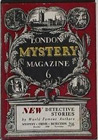 But one magazine seems to have endeared itself to the public imagination more than all the rest and, though it passed away 23 years ago, it still seems to be fondly remembered amongst at least one, maybe even two generations of readers. It also survived longer than any other British crime-fiction magazine – 32 years, from 1949 to 1982 – and so became something of an institution – thanks chiefly to its defiant latter-day publisher Norman Kark. It was the London Mystery Magazine – in later years called the London Mystery Selection, when it masqueraded as a paperback anthology rather than a magazine. But as time marches on, it too is in danger of becoming forgotten and so I want to take the chance to run through the magazine and remember at least some of its highlights. There’s too much to try and cover it all in one column, so I’m spreading it over this issue and next.
The first issue of LMM appeared in June 1949, though it was undated. In digest size, its 132 pages costing 2/6d (that’s 12½p), it was published by Hulton Press and edited by Michael Hall, assisted by fellow Manchester Guardian journalist John Shand. In a stroke of either genius or madness, Hall managed to get the Post Office to assign the address of Sherlock Homes, 221b Baker Street, to LMM, and that remained the address for the next 15 issues. Hall remarked that in the first month he had received 300 airmail letters alone, plus inland post, and was awaiting the boat mail. The attendant publicity certainly put LMM on the map. And Hall did everything he could to keep it there. The magazine had a distinctive front cover by Joan Hassall which featured different aspects of London mystery within an ornate regency design. It was also liberally illustrated throughout with line drawings and woodcuts. The first issue alone could boast the names Mervyn Peake, Eric Fraser, Ronald Searle and Austin Osman Spare amongst the artists, and Pauline Baynes was a regular from the second issue. It’s Spare’s presence that makes these early issues harder to find these days at a decent cost, especially the fifth issue, which has a feature on Spare by Hannen Swaffer. The contents were a pleasant and diverse blend of fact and fiction, plus a regular lead-in poem by ‘Sagittarius’, a writer whose satirical poems appeared in the New Statesman and other political and literary journals and formed the basis for a half-dozen collections. The identity behind the alias is usually assigned to Olga Miller, wife of the actor Hugh Miller.
Hall clearly wanted to keep the magazine’s contents as varied as possible. It contained traditional detective stories – leading with Mary Fitt’s ‘The Case of the Thursday ‘Phone-calls’ – plus rather more villainous crime stories – Jack Trevor Story’s ‘Fame for Ferdinand’ being typically cranky. There were slightly more unusual mysteries, like Christopher Morley’s ‘Foggy Bottom’ and Lewis Spence’s ‘Lucifer Over London’, to the outright supernatural, with H Burgess Drake’s ‘Yak Mool San’ and Algernon Blackwood’s ‘The Trod’. The same diversity flavoured the non-fiction. Hannen Swaffer remembered back to his early days as a journalist and the part he played in the arrest of Dr Cippen, whilst Lillian de la Torre provided one of her historical crime reconstructions in ‘George Barnwell’. Stretching the definition of mystery a little wider, Claude Sykes delved into the possible real identity of Shakespeare, coming up with his own candidate, the Earl of Rutland. While among the mysteries of nature Christina Hole looked at how man communicates with horses, and Peter Scott puzzled over the sense of direction of homing pigeons. Perhaps the last two pushed ‘mystery’ in our favoured sense a little too far, but it gave the magazine a pleasing diversity. Sales were sufficient that Hulton was able to get another issue out for Christmas, with many of the same contributors (Blackwood, Story, Fitt, Hole, Drake) and, among the new ones, Kenneth Walker began a series of articles about medical and psychological mysteries.
 At the start of 1950 the restrictions on paper rationing were lifted and LMM was able to switch to a bi-monthly schedule with the third issue in April. This allowed Hall to develop several regular contributors and series, all of them highly original. Perhaps the best known was the series featuring Sollius, the Slave Detective, written by Wallace Nichols. This became the longest-running series in LMM. Set in the second century AD at the time of Marcus Aurelius and his son Commodus, these are the investigations of Sollius, slave of the senator Titius Sabinus, who becomes renowned throughout the Empire for his ability to solve crimes. Most unusual was a series of fantasy detective stories for children written by country doctor Liliane Clopet. They feature Shipshape Shilling, a sailor made of glass who lives on a ship in a bottle and who helps a young boy solve problems. Another series, initially presented anonymously or even as if they might be true, was ‘Clorinda’. Through her diary, the fashion-conscious Clorinda reveals secrets of her days first in Intelligence and then as a private detective. From issue number 8 this series was attributed to Charles Franklin, which was in turn an alias of Frank Usher. Usher wrote scores of books during the 1950s and 1960s under various pen names, but I’m not aware that this series, which ran to issue 15, made it into book form. Usher was Chairman of the Crime Writers’ Association in 1962/63.
Since the first issue, Mary Fitt had penned a series about solicitor Mr Pitt who is later helped in his investigations by his Siamese cat. From issue 7 she started a new series featuring Dr Fitzbrown, a country doctor with a sharp eye. Several of these stories made it into her 1954 collection The Man Who Shot Birds. Fitt was a pseudonym of long-time writer and classicist Kathleen Freeman, and under her own name she presented three legal cases from ancient Greece, starting with ‘Murder in Athens’ (6). Besides these series, LMM had other regulars. H Burgess Drake contributed a half-dozen macabre supernatural stories plus a genuine crime tale in issue 11. W Stanley Moss, who was just then establishing a reputation with his wartime thriller Ill Met by Moonlight (1950), contributed five strange stories, starting with ‘The Zombie of Alto Parana’ (6). Russell Kirk also contributed several weird tales, including his now classic ‘Behind the Stumps’ (4).
Hall was good at attracting new writers. The first issue carried the first story by Ronald Dunkley, set in a Japanese prisoner-of-war camp. Martin Greenlaw, about whom I know nothing, produced a short series about a Cockney Covent Garden porter with keen powers of observation, starting with ‘Suffering Finds a Corpse’ (issue 4). Robert Aickman, little known at that time, contributed a piece about his memories of Harry Price (issue 5). Ex-pat Yorkshireman turned South African resident Frederick E Smith contributed six unusual stories overall, including the story of a jewel and a taboo, ‘The Hole That Screamed’ (9). But Hall didn’t ignore the major writers. Algernon Blackwood contributed not only two stories to the first two issues but adapted a number of his radio talks, including two about his phobia of spiders and the fear of heights. The noted American mathematician, puzzle expert and Oz devotee, Martin Gardner, contributed two stories. The first was about the suicide of an artist, ‘The Horrible Horns’ (7), while the second was an unusual piece about a boy detective, ‘Crunchy Wunchy’s First Case’ (8). Brett Halliday, creator of Mike Shayne, wrote a story especially for LMM, ‘You Killed Elizabeth’, which explores an ingeniously constructed double crime. John Dickson Carr adapted his 1948 radio play ‘A Razor in Fleet Street’ as ‘Flight from Fleet Street’, but a planned series by Carr never eventuated.
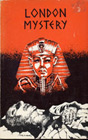
The diversity in LMM was remarkable, perhaps the most of any mystery magazine. I regard that as exciting, but perhaps it was too much for the readers of the day. The circulation cannot have been sufficient to sustain alongside the rapid rise in the price of paper and printing costs. After issue 15 in April-May 1952, it was suddenly dropped, without warning. Later that year Hulton issued an anthology called Mystery, selecting the best from the magazine – a volume well worth tracking down. Most must have thought that was that. But it wasn’t. A year and a month later, in June 1953, the magazine suddenly reappeared, looking outwardly just the same, but now published by Norman Kark and with his son, Austen Kark, as editor. Just what he did with it I’ll explore next time round.